Every glass of tap water, whether from municipal lines or borewells, carries a diverse cocktail of unseen impurities. These contaminants, ranging from microscopic organisms to dissolved chemicals, can significantly impact your health, the taste of your water, and even the lifespan of your appliances. Understanding what these impurities are and how filtration systems tackle them is the first step towards ensuring truly safe drinking water.
For residents in Bangalore and Hyderabad, where water sources are notoriously varied, a robust and multi-stage water filtration system is not just a convenience—it’s a necessity. At Aquadrop, our advanced water purifier rental solutions are specifically designed to eliminate this wide spectrum of typical impurities, giving you peace of mind with every sip.
The Unseen World in Your Water: Common Impurities
Water, by nature, is an excellent solvent, picking up various substances as it travels through the environment and plumbing infrastructure. Here are the most common categories of impurities found in urban tap water:
1. Physical Impurities (Particulate Matter)
These are visible or suspended solids that make your water cloudy or murky.
- Examples: Sand, silt, clay, rust particles (from corroding pipes), dust, turbidity.
- Sources: Borewells, aging municipal pipes, water main breaks, surface water runoff during monsoons.
- Why they’re harmful: While not always directly toxic, they affect taste, clog pipes, damage appliances, and can shield microorganisms from disinfection.
- How Filters Remove Them: Primarily by Sediment Filters (mechanical barrier).
2. Chemical Impurities (Dissolved Solids & Gases)
These are substances dissolved in the water, often invisible, that can alter taste, odor, and pose significant health risks.
- Examples:
- Total Dissolved Solids (TDS): High levels of inorganic salts like calcium, magnesium, sodium, potassium. (Cause of Hard Water).
- Heavy Metals: Lead, arsenic, mercury, cadmium, chromium (from industrial pollution, old plumbing).
- Chlorine/Chloramines: Disinfectants added to municipal water (cause bad taste/odor).
- Fluoride: Naturally occurring, but excessive levels are harmful.
- Nitrates/Nitrites: From agricultural runoff, sewage.
- Pesticides & Herbicides: From agricultural runoff.
- Volatile Organic Compounds (VOCs): From industrial solvents, fuels.
- Hydrogen Sulfide Gas: Causes “rotten egg” smell (common in borewells).
- Sources: Natural geology, industrial discharge, agricultural activity, sewage, water treatment processes, aging plumbing.
- Why they’re harmful: Can lead to long-term health issues (kidney stones, neurological damage, cancer), bad taste, and odor.
- How Filters Remove Them: Primarily by Activated Carbon Filters (adsorption), RO (Reverse Osmosis) Membranes (molecular separation), and sometimes Specialized Filters (e.g., for fluoride).
3. Biological Impurities (Microorganisms)
These are living microscopic organisms that can cause severe waterborne diseases.
- Examples: Bacteria (e.g., E. coli, Salmonella), viruses (e.g., Hepatitis A, Rotavirus), cysts (e.g., Giardia, Cryptosporidium).
- Sources: Contaminated water sources (sewage leaks, animal waste), compromised distribution systems (leaking pipes).
- Why they’re harmful: Cause acute illnesses like cholera, typhoid, dysentery, gastroenteritis.
- How Filters Remove Them: Primarily by UV (Ultraviolet) Sterilization (deactivation), RO (Reverse Osmosis) Membranes (physical blocking), and UF (Ultra Filtration) Membranes (physical blocking).
4. Radiological Impurities
These are radioactive elements that can be naturally occurring or from man-made sources.
- Examples: Uranium, Radium.
- Sources: Natural mineral deposits in groundwater, some industrial activities.
- Why they’re harmful: Long-term exposure increases cancer risk.
- How Filters Remove Them: Primarily by RO (Reverse Osmosis) Membranes.
5. Microplastics
Tiny plastic fragments, an emerging global concern.
- Examples: Nanoplastics, microfibers, plastic beads.
- Sources: Breakdown of plastic products, wastewater discharge.
- Why they’re harmful: Potential for chemical leaching and physical irritation; long-term health effects still under study.
- How Filters Remove Them: Primarily by RO (Reverse Osmosis) Membranes and highly effective UF (Ultra Filtration) Membranes.
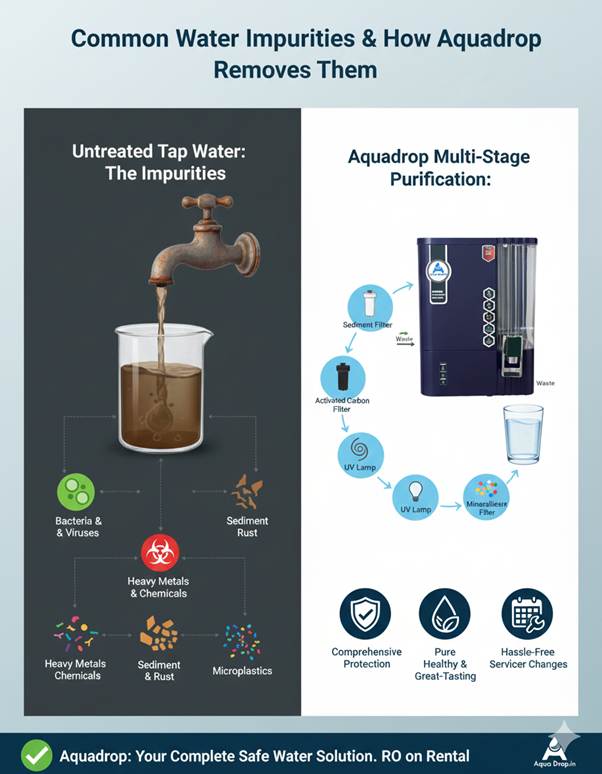
Aquadrop.in: Your Multi-Stage Defense System
For comprehensive protection against this vast array of impurities, a multi-stage purification system is indispensable. Aquadrop’s water filter rental in Bangalore offers exactly this:
- Sediment & Carbon Filters: Tackle physical impurities, chlorine, and organic contaminants.
- RO Membrane: The ultimate barrier against high TDS, heavy metals, pesticides, and microplastics.
- UV Sterilization: Ensures biological safety, eliminating bacteria and viruses.
- Mineralizer/Alkaline Filter: Rebalances beneficial minerals and pH for optimal health and taste.
Don’t guess what’s in your water. Let Aquadrop provide a guaranteed solution that removes the typical impurities and protects your family’s health, effortlessly and affordably.
Read More :- water filter rental Bangalore